Shqadaf Company For Transportation: Reliable Transport Services in Saudi Arabia
Shqadaf Company For Transportation is a trusted name offering comprehensive passenger and cargo transportation services across Saudi Arabia. Our expertise covers a wide range of transport solutions, including bus, limousine, and car rental services that cater to both group travel and individual needs.
Our Services

At Shqadaf Company For Transportation, we specialize in safe, punctual, and comfortable transportation for passengers as well as efficient cargo delivery within Saudi Arabia. Our primary services include:
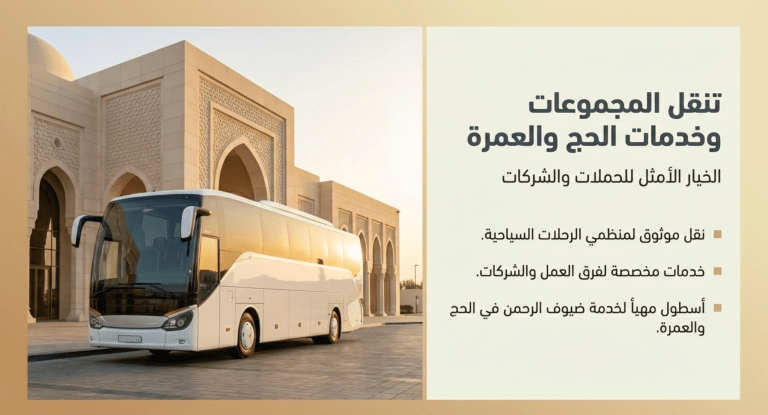
- Bus Rental Service
Ideal for large groups such as tour operators, corporate teams, or pilgrimage groups needing dependable transport. - Limousine Service
Luxury transportation options for VIP clients, business travelers, or special occasions. - Car Rental Service
Flexible car rental options suited for individual travelers or small groups seeking convenient mobility.
Our Mission
Our mission at Shqadaf Company For Transportation is straightforward and customer-focused:
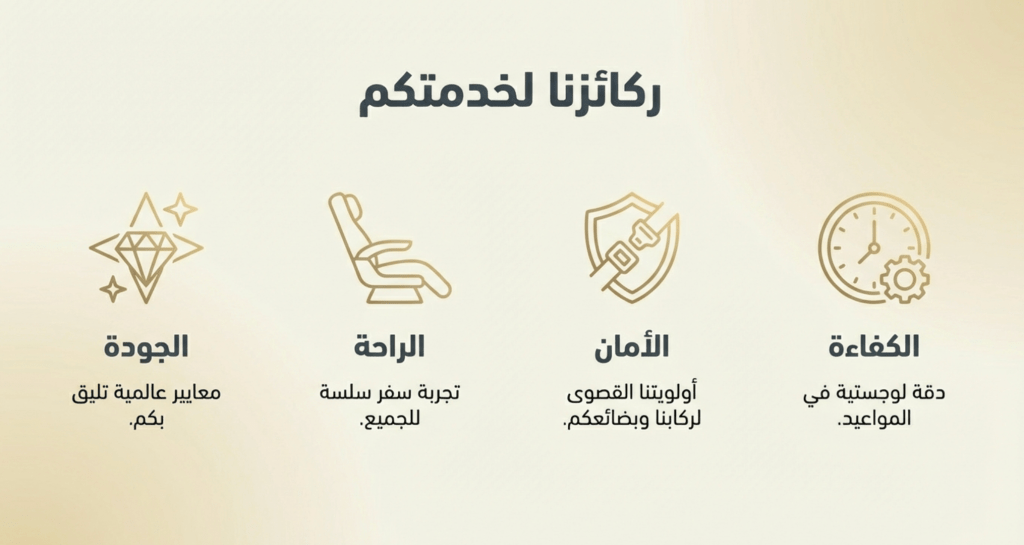
- Quality – Deliver high-standard transportation services that meet diverse client requirements.
- Comfort – Ensure a smooth and comfortable travel experience for all passengers.
- Safety – Prioritize the safety and well-being of our passengers and cargo.
- Efficiency – Optimize logistics to guarantee timely and reliable cargo deliveries inside Saudi Arabia.
Providing efficient and top-quality transport services remains at the heart of everything we do.
Why Choose Shqadaf Company For Transportation?
Choosing the right transportation partner can make all the difference in travel and shipment experiences. Here’s why Shqadaf stands out:
- Experienced and Professional Team: Skilled drivers and staff trained to offer superior service.
- Modern and Well-Maintained Fleet: A diverse and updated lineup of buses, limousines, and cars.
- Customized Solutions: Tailored transport options to meet individual or group travel needs.
- Competitive Pricing: Affordable rates without compromising on quality or safety.
- Excellent Customer Support: Responsive and helpful service from inquiry to journey completion.
Contact Us
For inquiries, bookings, or more information about our services, feel free to reach out:
- Address: [company address]
- Phone: [company phone number]
- Email: [company email address]
Stay connected and updated by following us on social media:
[company social media links]
Multilingual Support
To better serve our diverse clientele, Shqadaf Company For Transportation proudly offers information and customer support in multiple languages, including English and Arabic.
About Shqadaf Company For Transportation
Operating in key cities such as Makkah, Shqadaf Company For Transportation is committed to supporting Umrah pilgrims, tourists, and businesses requiring dependable transport solutions. From group bus rentals for religious journeys to individual car rentals for sightseeing or business travel, we strive to facilitate smooth transportation experiences throughout Saudi Arabia.
Summary
Shqadaf Company For Transportation is your go-to provider for reliable, comfortable, and safe passenger and cargo transportation services in Saudi Arabia. Whether you need to rent a bus, book a limousine, or hire a car, our diverse service portfolio and dedication to quality ensure your travel or shipping needs are professionally managed.
For seamless, efficient transportation solutions, trust Shqadaf Company For Transportation — moving you forward!
Note: Please replace placeholders like [company address], [company phone number], and [company email address] with the actual details when publishing.

LOCATION: https://goo.gl/maps/XjtUaumyJgRbWhkr6
شركة شقادف
CG93+J9V, Makkah 22846
العنوان: Az Zahir, 6102، Makkah 24222, Saudi Arabia / مكة، منطقة مكة
TEL: 966125601919
TEL: 966125601717
TEL: 0122889509
Strategic Operational Assessment:
Shqadaf Company for Transportation and the Evolution of Pilgrim Logistics in Saudi Arabia
1. Introduction
The logistics of the Hajj and Umrah pilgrimages in the Kingdom of Saudi Arabia constitute one of the most complex, high-stakes, and large-scale human mobility challenges in the contemporary world.
Each year, millions of pilgrims converge on the Holy Sites of Makkah and Madinah, creating a demand for transportation infrastructure that must be at once robust, scalable, and meticulously coordinated. Within this dynamic ecosystem, Shqadaf Company for Transportation (officially registered as Shqadaf Company for Transportation and Services for Umrah Pilgrims and Visitors) has established itself as a significant operational entity.
This report provides an exhaustive, multi-dimensional analysis of Shqadaf Company, examining its corporate structure, operational footprint, service diversification, and strategic positioning within the broader Saudi transport market.
The analysis goes beyond a superficial capability assessment to explore the geopolitical, economic, and regulatory contexts that define the company’s operating environment. By synthesizing specific data points—ranging from fleet movement logs and licensing statutes to geographic infrastructure details—this report reconstructs the operational reality of Shqadaf Company.
It situates the firm not merely as a bus operator, but as an integrated logistics provider navigating the transformative pressures of Saudi Vision 2030, the “Guests of God” (Doyof Al Rahman) Program, and the rigorous oversight of the General Syndicate of Cars (Naqaba).
The report is structured to guide the reader through the concentric circles of Shqadaf’s business environment: beginning with the macro-regulatory landscape, narrowing to the company’s specific corporate and physical infrastructure, analyzing its diversified service portfolio (transport, catering, marketing), and concluding with a strategic outlook on its competitive viability in an era of digital transformation and fleet modernization.
2. The Macro-Regulatory Environment: The General Syndicate of Cars (Naqaba)
To understand the operational parameters of Shqadaf Company, one must first dissect the governing body that dictates the existence of every Hajj transport entity in the Kingdom: The General Syndicate of Cars (Naqaba). Shqadaf is not an independent actor in the free-market sense; it is a franchised operator within a state-managed cartel designed to ensure safety and reliability.
2.1 The Syndicate Architecture and Membership
The General Syndicate of Cars was established to replace the chaotic, informal transport systems of the early 20th century with a unified, accountable network. Membership in this Syndicate is mandatory for any company wishing to transport Hajj pilgrims. The research confirms that Shqadaf Company is an active member of this exclusive body, historically noted as the 16th company to join the Syndicate.1
This specific historical detail—being the 16th entrant—is significant. It places Shqadaf in the cohort of established, legacy operators rather than the wave of new, speculative entrants that have appeared in recent years. At the time of its accession, Shqadaf injected an initial fleet of 54 modern buses into the Syndicate’s collective pool.2 While the fleet size has undoubtedly fluctuated and grown since then to meet modern quotas, this initial capital expenditure demonstrates the company’s long-standing commitment to the sector and its ability to meet the high barriers to entry, which include substantial financial guarantees and technical auditing.
2.2 The “Tafweej” and “Nafrah” Command Structure
As a Syndicate member, Shqadaf’s operations during the critical days of Hajj are integrated into a central command system known as “Tafweej” (dispatching). The company does not simply choose its routes. The Ministry of Hajj and Umrah, in coordination with the Syndicate, assigns specific “Maktabs” (Pilgrim Service Offices) to Shqadaf.
This implies that Shqadaf’s operations team must maintain a 24/7 liaison channel with the Syndicate’s headquarters. During the “Nafrah”—the mass movement from Arafat to Muzdalifah after sunset on the 9th of Dhul-Hijjah—Shqadaf’s buses operate as part of a synchronized wave. The ability to execute this maneuver without breakdown or delay is the primary metric by which the Ministry evaluates the company. The “Ready for Delivery” status codes seen in recent bus movement reports 3 are evidence of this tight integration, showing that Shqadaf’s assets are tracked, audited, and deployed via a centralized digital logistics ledger.
2.3 Financial Compliance and Barriers to Entry
The regulatory landscape is designed to filter out financially unstable operators. According to Article 12 of the relevant bylaws 4, companies like Shqadaf must maintain an irrevocable bank guarantee of SAR 200,000 in favor of the Ministry. This bond acts as a safeguard for pilgrims; should the company fail to provide contracted services (e.g., a bus fails to show up at a hotel), the Ministry can liquidate this bond to procure emergency transport from a competitor.
Furthermore, the company must prove its legal standing through a valid Commercial Registration and a documented management hierarchy, including a Director General and Branch Directors.4 This requirement ensures that there is always a legal representative accountable for the safety of the thousands of pilgrims under the company’s care. The penalties for circumventing these regulations are severe, including fines of up to SAR 100,000, deportation of expatriate staff, and confiscation of vehicles.5 The fact that Shqadaf remains an active, listed entity 7 amidst such strict enforcement suggests a robust internal compliance department capable of navigating the Ministry’s complex bureaucratic requirements.
3. Corporate Infrastructure and Strategic Geography
Shqadaf Company’s physical footprint is not random; it is a calculated response to the geography of the Holy Cities and the logistical arteries that connect them. The company operates a dual-hub structure, separating its administrative brain from its operational muscle.
3.1 Headquarters: The Administrative Hub (Jeddah)
The company’s corporate headquarters are located in Jeddah, specifically in the Al Salamah District, on the Southbound Madinah Road, within the Al Humaidhi Tower.
| Attribute | Detail | Strategic Analysis |
| District | Al Salamah, Jeddah | An upscale, commercial district central to Jeddah’s business operations. |
| Arterial Access | Madinah Road (Southbound) | Madinah Road is the spine of Jeddah. It connects the city center directly to King Abdulaziz International Airport (KAIA). |
| Building | Al Humaidhi Tower | Indicates a professional corporate frontage, necessary for meeting foreign Hajj missions and banking partners. |
Strategic Relevance: Locating the HQ on Madinah Road is logistically critical. This road is the primary vector for pilgrims arriving by air. Shqadaf’s management team in Al Salamah is positioned minutes away from the Ministry of Hajj’s Jeddah branches and the airport’s administrative zones. This proximity is vital for processing the thousands of visas, bus permits, and driver accreditations required before the season begins. The “Southbound” orientation suggests easy access towards the city center and the port, or a quick U-turn to head north towards the airport and the Madinah highway.
3.2 Operational Base: The Logistical Heart (Bahra)
While deals are signed in Jeddah, the actual work happens in Bahra. The research identifies a Shqadaf Company Branch located in Bahra (Old East), on the Old Jeddah-Makkah Road.10
The Strategic Value of Bahra:
Bahra is a town situated in the valley between Jeddah and Makkah. For a Hajj transport company, this location is arguably superior to being inside Makkah city itself.
- Cost Efficiency: Real estate in Makkah is among the most expensive in the world. Basing a sprawling bus depot and maintenance yard in Bahra significantly reduces overheads.
- Traffic Management: During Hajj, Makkah is locked down. Moving a bus in or out of the central zone for repairs is nearly impossible due to pedestrian density. Bahra, located just outside the “Haram” boundary but close to the entry checkpoints, allows Shqadaf to stage its fleet. Buses can be deployed into Makkah rapidly when needed, or pulled back to Bahra for service without getting stuck in the gridlock of the Holy City.
- Maintenance Capabilities: The snippet explicitly mentions a “maintenance workshop for cars and buses” at this location.10 This is the company’s most critical asset. In the scorching heat of the Hijaz summer (often exceeding 45°C), bus engines, air conditioning units, and tires face extreme stress. Having an in-house facility to weld, repair AC compressors, and change tires ensures high fleet availability. It reduces reliance on third-party mechanics, which is both costly and slow during peak season.
3.3 Communication and Identity
The company utilizes standard corporate communication channels, including a dedicated P.O. Box (52051, Jeddah 21563) and Fax (6515233).9 While the digital footprint is fragmented across various directories and Umrah aggregator sites, this is typical for the B2B nature of the industry. Hajj contracts are rarely signed via a website “checkout” button; they are negotiated in person or via long-standing agency relationships. The company operates under variations of the name “Shqadaf for Transport and Umrah and Visitor Services”, highlighting its license to operate across multiple verticals.9
4. Service Portfolio Diversification: Beyond Transportation
A key insight from the research is that Shqadaf has evolved beyond a pure-play transport operator. The company has engaged in horizontal integration, adding complementary services to capture a larger share of the pilgrim’s expenditure and offer a “turnkey” solution to international travel agents.
4.1 Core Pillar: Pilgrim Mobility (Hajj & Umrah)
Transportation remains the revenue backbone. The company provides:
- Arrival Transfers: High-frequency shuttles between King Abdulaziz International Airport (JED) and hotels in Makkah.
- Inter-City Coaching: Long-haul trips between Makkah and Madinah (approx. 450 km).
- Ziyarat Tours: Short, localized trips to religious sites such as Jabal Al-Noor, Arafat (for sightseeing), and Quba Mosque in Madinah.
- Hajj Operations: The specialized movement between the Holy Sites (Mina, Muzdalifah, Arafat) during the five days of Hajj.
Fleet Dynamics: The company utilizes a mix of vehicles. While it started with 54 buses 2, modern operations typically require a diverse fleet.
- Standard Coaches: 49-seater buses (e.g., Mercedes Travego, Yutong, Zhongtong) for mass movement of budget-conscious pilgrims from South Asia and Africa.
- VIP/Luxe Transport: To cater to the growing market of “Premium Umrah,” companies like Shqadaf often deploy smaller, luxury coaches (30-seaters with extra legroom) or GMC/Hyundai vans for private families. The snippet mentioning “H1 Car” prices (e.g., 300 SAR Jeddah-Makkah) 11 indicates that Shqadaf participates in the small-vehicle market as well, likely competing with ride-hailing apps and private taxis.
4.2 Secondary Pillar: Catering Services (Subsistence)
Shqadaf holds a license for “cooked catering services”.9 This is a strategically brilliant diversification.
- The Problem: During Hajj, feeding pilgrims is a logistical nightmare. Traffic makes food delivery unreliable.
- The Solution: By owning both the bus and the kitchen, Shqadaf can synchronize meal delivery with transport schedules. They can offer a Hajj Mission a contract that reads: “We will pick your pilgrims up from the airport, drive them to Makkah, and provide their boxed meals during the bus ride and at their camps in Mina.”
- Revenue Impact: Catering offers higher margins than transport and utilizes different supply chains, hedging the company against fuel price hikes or transport regulatory changes.
4.3 Tertiary Pillar: Marketing and Ground Handling
The registration for “marketing services for others” and “organizing services for Umrah pilgrims” 9 suggests Shqadaf acts as a Ground Handling Agent (GHA).
- B2B Agency: International travel agencies (e.g., in Indonesia, Turkey, or Russia) cannot legally operate their own buses in Saudi Arabia. They must contract a local Saudi entity. Shqadaf markets itself to these foreign agencies, acting as their “man on the ground.”
- Service Scope: This likely involves meet-and-greet services at the airport, handling lost luggage, and coordinating hotel check-ins. It transforms Shqadaf from a “bus company” into a “Destination Management Company” (DMC).
5. Operational Analysis: The Pilgrim Journey Simulation
To understand the complexity of Shqadaf’s daily operations, we can simulate the lifecycle of a service contract based on the available data and industry standards.
Phase 1: The Booking and Allocation
Months before Hajj, Shqadaf’s marketing team (likely based in the Jeddah HQ) secures contracts with foreign missions. These contracts are registered with the Ministry’s “Nuysk” electronic platform. The Syndicate assigns Shqadaf a quota of pilgrims based on their fleet capacity. The bank guarantee 4 is verified to ensure coverage.
Phase 2: Fleet Preparation (The Bahra Hub)
In the weeks leading up to the season, the Bahra workshop 10 is a hive of activity.
- Mechanical Audit: Every bus undergoes a mandatory check. AC units—critical for survival—are flushed and refilled. Cooling systems are pressure-tested.
- Permit Application: Each bus receives a “Hajj Permit” sticker. Without this, the vehicle will be confiscated at the checkpoints ringing Makkah.6
- Driver Deployment: Seasonal drivers arrive. Shqadaf’s HR team processes their temporary visas and conducts training on the specific routes and the use of the GPS tracking units mandated by the Syndicate.
Phase 3: The Arrival (Jeddah Operations)
Pilgrims land at the Hajj Terminal in Jeddah. Shqadaf’s supervisors, stationed at the airport plaza, receive the group. Using the “Tafweej” app, they scan the group’s barcode and summon a bus from the holding area. The bus driver, monitored via the control center, navigates the heavy traffic of Madinah Road 9 to load the pilgrims and their luggage.
Phase 4: The Mashaer Movement (The Critical Test)
During the five days of Hajj, the buses operate in a closed loop. Shqadaf buses are likely assigned to a specific “Maktab” (e.g., Maktab 40 for South Asian pilgrims).
- The Challenge: Moving thousands of people from Arafat to Muzdalifah in a window of 6 hours.
- The Execution: The buses run bumper-to-bumper. Breakdowns are not an option. If a Shqadaf bus overheats, the Bahra maintenance team must deploy a mobile repair unit on a motorbike (to cut through traffic) or a tow truck immediately. The “Ready for Delivery” status in the tracking logs 3 becomes the most watched metric in the control room.
Phase 5: Post-Hajj and Departure
After the rituals, the fleet pivots to “Departure Mode,” shuttling pilgrims back to Jeddah or on to Madinah. The catering division 9 might provide “farewell meals” for the journey. Once the season ends, the fleet returns to Bahra for deep maintenance and long-term storage or leasing for the Umrah season.
6. Competitive Landscape and Market Positioning
The market for pilgrim transport in Makkah is tiered, and understanding Shqadaf’s position requires comparing it to its peers.
6.1 The Competitive Hierarchy
| Tier | Characteristics | Examples | Shqadaf’s Position |
| Tier 1: The Giants | Fleets of 1,000+ buses. Government-backed or massive conglomerates. Handle national-level contracts (e.g., transporting the entire Indonesian contingent). | SAPTCO (Saudi Public Transport Co), Hafil (Naghi Group). | Shqadaf is not in this tier. It lacks the multi-thousand bus scale. |
| Tier 2: The Mid-Market Specialists | Fleets of 100-500 buses. agile, privately owned. Focus on service quality and specific markets (e.g., CIS, Turkey, MENA). Diversified services. | Shqadaf, Rawahel Al Mashaer, Rabitat Makkah, Qawafil International. | This is Shqadaf’s home. Competing on agility and bundled services (catering). |
| Tier 3: The Sub-Contractors | Small fleets (<50 buses). Often older vehicles. Rely on sub-contracting from Tier 1 companies during peak crunch. | Smaller local establishments. | Shqadaf has graduated from this tier by joining the Syndicate and owning significant infrastructure. |
6.2 Strategic Differentiation
Shqadaf differentiates itself through specialization.
- Geographic Focus: While SAPTCO runs buses all over Saudi Arabia (Riyadh, Dammam), Shqadaf is hyper-focused on the Makkah-Jeddah-Madinah triangle. This allows for deeper local knowledge and better relationships with local traffic police and Mutawwifs.
- Market Niche (The CIS Factor): The presence of Russian-language reviews and feedback 12 suggests Shqadaf has successfully cultivated the Commonwealth of Independent States (CIS) market. This is a lucrative niche; pilgrims from Uzbekistan, Kazakhstan, and Russia are growing in numbers and often pay a premium for reliable service, unlike the commoditized bulk contracts of South Asia.
- Service Integration: The ability to offer catering 9 gives Shqadaf a unique selling proposition (USP). A tour operator can deal with one vendor for two major cost centers (transport + food), simplifying their operations.
6.3 Brand Perception
Reviews indicate a generally positive reputation.12 Phrases like “Impeccable service” and “Great experience” 13 point to a company that takes quality control seriously. However, like all operators, they are subject to the chaos of Hajj. The existence of a formal “Complaint to Supervisor” channel 14 is a positive indicator of mature corporate governance—they acknowledge that problems happen and have a process to resolve them.
7. Financial and Economic Analysis
While Shqadaf is a private company and does not publish public balance sheets, we can reconstruct its economic model based on industry data.
7.1 Revenue Drivers
- Hajj Season (Peak): This provides 60-70% of annual revenue. Prices are inelastic; demand exceeds supply. A single seat on a bus for the 5-day Hajj period can command thousands of Riyals depending on the service level.
- Umrah Season (Base Load): With the season now extending to 10 months (Muharram to Shawwal), this provides steady cash flow. Margins are tighter, but volume is high.
- Ancillary Revenue: Catering contracts and marketing commissions from hotel bookings add “pure profit” layers on top of the asset-heavy transport business.
7.2 Cost Structure
- Capital Expenditure (CapEx): Buses are expensive assets (approx. SAR 400k – 600k per unit for Chinese models like Yutong; >SAR 1M for Mercedes). They depreciate rapidly due to the climate.
- Operational Expenditure (OpEx):
- Staff: Driver visas, housing, and salaries.
- Fuel: Diesel prices in KSA have risen, increasing operating costs.
- Maintenance: The Bahra workshop is a cost center but saves money long-term compared to outsourcing.
- Regulatory Fees: The SAR 200,000 bank guarantee 4 and per-seat fees paid to the Syndicate.
8. Strategic Outlook: Vision 2030 and Future Challenges
The future for Shqadaf Company is inextricably linked to the Saudi government’s Vision 2030, which aims to host 30 million pilgrims annually.
8.1 The Growth Opportunity
The sheer volume of projected pilgrims guarantees demand. The market is expanding faster than the Tier 1 giants can absorb, leaving ample room for Tier 2 players like Shqadaf to grow. The extension of the Umrah visa system to tourists also opens up the “Free Independent Traveler” (FIT) market, which Shqadaf can target with its smaller vehicles and VIP vans.
8.2 The Modernization Threat
The government is pushing for a “Green Hajj.” Future regulations may ban diesel buses in the Holy Sites, mandating electric or hydrogen buses.
- Impact on Shqadaf: This will require massive capital investment. The current fleet will eventually become obsolete. Shqadaf will need to secure financing to purchase electric buses and install charging infrastructure at its Bahra facility.
- Digitalization: The Ministry is moving towards a fully digital Hajj. Shqadaf must continue to invest in its IT infrastructure to integrate with the “Nuysk” app. If they cannot offer real-time digital booking and tracking to the end-user, they risk becoming a “dumb pipe” provider, commoditized by digital aggregators.
8.3 Conclusion
Shqadaf Company for Transportation is a resilient, mature, and strategically positioned player in the Makkah transport ecosystem. By leveraging its dual-hub infrastructure in Jeddah and Bahra, complying strictly with the General Syndicate of Cars’ rigorous standards, and diversifying into catering and marketing, it has built a defensive moat against market volatility.
For external partners, Shqadaf represents a stable, mid-sized alternative to the massive conglomerates—capable enough to handle complex logistics (as evidenced by its historical fleet size and Syndicate membership) but agile enough to offer personalized services to specific markets like the CIS region. Its future success will depend on its ability to navigate the capital-intensive transition to green transport and the digital integration required by the Kingdom’s ambitious tourism goals.
Appendix: Comparative Data Tables
Table 1: Corporate Profile Summary
| Metric | Details | |
| Official Name | Shqadaf Company for Transportation and Services for Umrah Pilgrims and Visitors | |
| Headquarters | Al Humaidhi Tower, Madinah Road, Al Salamah Dist., Jeddah | |
| Operational Hub | Old Jeddah-Makkah Road, Bahra (Old East) | |
| Postal Address | P.O. Box 52051, Jeddah 21563 | |
| Primary License | Member, General Syndicate of Cars (Naqaba) | |
| Diversified Services | Transport, Cooked Catering, Marketing |
Table 2: Shqadaf vs. Market Competitors
| Feature | Shqadaf Company | SAPTCO (Market Leader) | Specialized Hajj Operators (e.g., Rawahel) |
| Scale | Mid-Tier (Hundreds of buses) | Tier 1 (Thousands of buses) | Mid-Tier |
| Geographic Scope | Makkah/Jeddah/Madinah Focus | National (All KSA) & International | Makkah Focus |
| Service Mix | Transport + Catering + Marketing | Transport + Logistics | Transport + Accommodation (often) |
| Target Market | B2B (Agencies), Specific demographics (CIS) | Mass Market, Govt Contracts | Specific Ethnic Markets (South Asia/Turkey) |
| Infrastructure | Private Workshop (Bahra) | Massive National Depots | Private Depots |
(End of Report)
Источники
- لجنة مراقبة نقل الحجاج تبحث جوانب السلامة لحافلات ضيوف الرحمن – صحيفة عكاظ
- نقل الحجيج بين المشاعر – صحيفة اليوم
- Bus Movement Report | PDF – Scribd
- Chapter 2 – Procedures For Obtaining a License – Hajj, Ministry of
- Saudi Arabia introduces new Hajj transport rules; fines up to SR100,000 ($27,000) | World News – The Times of India, дата последнего обращения: января 27, 2026, timesofindia.indiatimes.com
- Interior Ministry Arrests 17 for Transporting Pilgrims Without Hajj Permits – وكالة الأنباء السعودية, дата последнего обращения: января 27, 2026, spa.gov.sa/en
- UMRAHAJJ – Bus – Google, дата последнего обращения: января 27, 2026, sites.google.com
- 60 Transportation Companies in Saudi Arabia – – newhaj, дата последнего обращения: января 27, 2026, newhaj.com/places
- شركه شقادف للنقل وخدمات المعتمرين والزوار – دليل السعودية العالمي …, дата последнего обращения: января 27, 2026, directoryksa.com
- فرع شركة شقادف للنقل والمعتمرين والزوار – دليل السعودية العالمي للأعمال, дата последнего обращения: января 27, 2026, www.directoryksa.com
- Transportation services (H1) – قافلة التوحيد, дата последнего обращения: января 27, 2026, qafilat-altawhid.com
- Jamal Yousef Al-Zuwaidi Hajj Company 2030 – NewHaj, дата последнего обращения: января 27, 2026, newhaj.com
- Makkah Gateway Reviews | Read Customer Service Reviews of makkahgateway.co.uk – Trustpilot, дата последнего обращения: января 27, 2026, trustpilot.com
- هاتف و عنوان | شركة شقادف … ماتبحث عنه بالقرب منك, дата последнего обращения: января 27, 2026, arbyy.com/cuboyt.html